

Contrary to popular belief, champagne isn’t necessarily a wine meant to be drunk immediately. When stored properly, it can age gracefully for several years, developing more complex aromas and a fuller body. However, not all champagnes are meant for aging. Their aging potential depends mainly on their style, vintage, and storage conditions. Some of the great houses even produce cuvées specifically designed to age over several decades, provided their structure, acidity, and balance allow for it.
There is no universal rule for aging champagne. It all depends on the wine’s structure and the philosophy behind the cuvée.
Multi-vintage champagnes (or "Brut Sans Année") are made from blends of several vintages to ensure a consistent style. They are generally not intended for long-term aging. The ideal time to drink them is usually between 1 and 3 years after purchase.
Vintage champagnes, on the other hand, are made from grapes harvested in a single year, selected for their exceptional quality. These wines often possess the structure and concentration needed for aging. Depending on the cuvée, they can be cellared for 5 to 15 years, or even longer for the grand cuvées. The vintage indicates an exceptional year with strong aging potential.
Another factor influences aging potential: dosage, that is, the amount of sugar added during the final blending stage. On the one hand, extra-dry champagnes (with less than 6g of sugar per liter) are more taut, precise, and mineral-driven. Their low sugar content makes them slightly more susceptible to oxidation, especially after opening. They are often intended to be enjoyed relatively young to preserve their freshness. On the other hand, demi-secs (containing between 32 and 50g per liter) can sometimes age better over time, thanks to their higher sugar content. Sugar acts as a natural stabilizer, which can promote a slower evolution, particularly for styles intended as dessert wines.
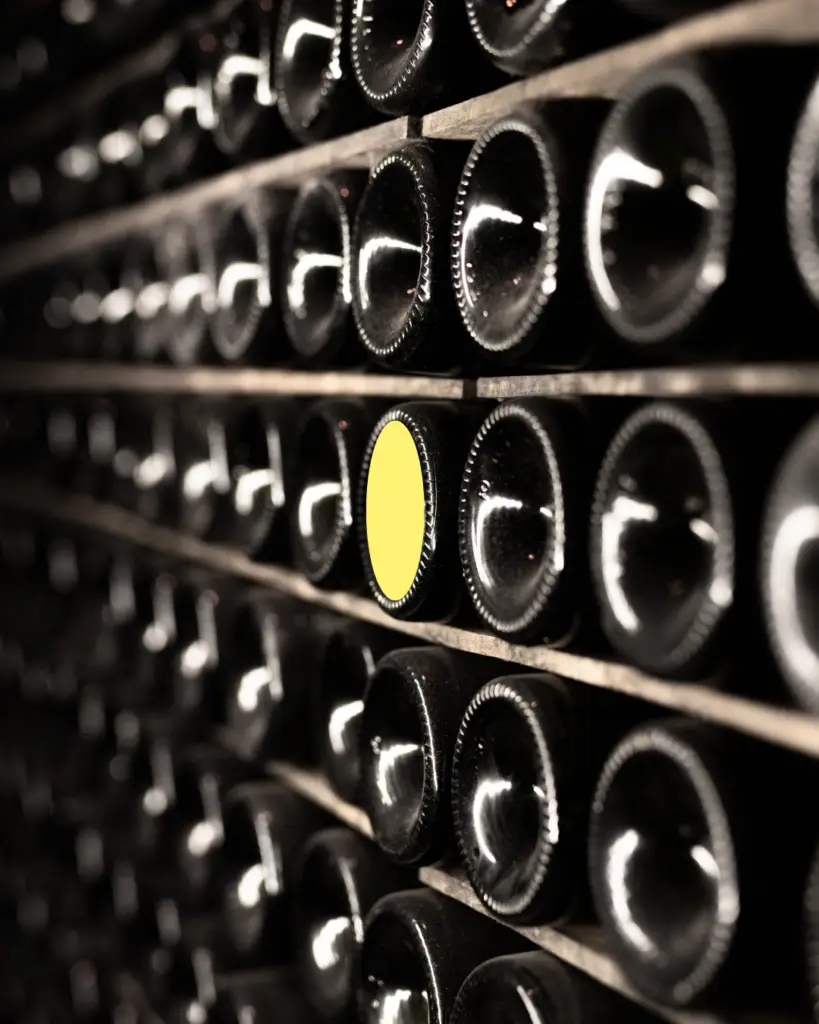
For champagne to age properly, its environment must remain stable and controlled.
Temperature is a key factor. Like any wine, champagne should be stored in a cool place at a constant temperature, ideally between 10 and 12°C. A dedicated wine cellar or wine cabinet is often the most reliable way to maintain these conditions over time, especially in homes where temperatures can fluctuate with the seasons. Temperature shocks should be avoided as much as possible, as they can lead to a loss of aromas, accelerated aging, a less fine mousse, and, most importantly, fewer bubbles in the wine. These phenomena are primarily due to the dissolution of carbon dioxide (CO₂) in the wine. The pressure inside champagne bottles can reach approximately 6 bars, which is almost equivalent to that of a truck tire. If the temperature changes suddenly, the internal pressure can shift rapidly, potentially weakening the cork and/or the bottle. In some cases, this can cause the bottle to break. This phenomenon occurs particularly when a bottle is left in the freezer for too long.
In addition, champagne should be stored away from light, especially UV rays. UV rays can cause what is known as a “light-induced off-flavor,” which is an irreversible alteration of the aromas. This effect is even more pronounced in clear, transparent glass bottles.
Humidity (the moisture level) also plays a very important role. For proper storage, it should be around 70%. If there is too much humidity, the label will be damaged. If there isn’t enough, the cork may dry out and shrink, which could compromise the bottle’s seal.
Finally, stability is a factor that is often overlooked. Repeated vibrations—such as those caused by a washing machine, a motor, or a ventilation system—can disrupt the wine’s aging process. A quiet, stable cellar is therefore the ideal environment.
A common question is: should champagne be stored upright or on its side? The answer depends on how long you plan to keep it. For long-term storage, it’s best to store bottles on their side to maintain contact between the wine and the cork. For short-term storage, a bottle can be kept upright without any problem. Unlike still wines, the high pressure of carbon dioxide helps keep the cork moist. This is why storage position is slightly less critical for champagne. Nevertheless, for enthusiasts looking to build a small cellar, storing bottles on their side remains the most commonly recommended approach as a precaution.
Even under ideal conditions, champagne can eventually pass its peak. There are certain signs that can help you tell. First, the wine’s color is an initial indicator. If the hue turns dark amber or brownish, there’s a good chance the wine has oxidized. Upon opening, a complete lack of bubbles is generally a bad sign, indicating a loss of carbonation. However, even if the effervescence has faded, the wine is still perfectly drinkable. The champagne loses its effervescence, offering an experience closer to that of a still wine, where freshness and aromatic complexity still shine through. Finally, aromas are often the most revealing indicator. A past-its-prime champagne may exhibit notes of overripe apple, vinegar, or even excessive maderization. These aromas indicate advanced oxidation of the wine.
The aging of champagne depends above all on a balance between the cuvée’s style, its vintage, and storage conditions. A stable temperature, darkness, controlled humidity, and the absence of vibrations are all essential for preserving the wine’s quality over time. When stored properly, champagne can reveal beautiful aromatic complexity and age gracefully. But beyond the technical rules, what matters most is the joy of the moment: a bottle of champagne is always better when shared.

To access the JOSEPH PERRIER website, you must be 18 or over.PLEASE enter your date of birth
We use cookies
Cookie Policy and Privacy Policy
ALCOHOL ABUSE IS DANGEROUS FOR YOUR HEALTH. CONSUME IN MODERATION. Sale of alcoholic beverages to minors under 18 years of age is prohibited. Proof of age is required at the time of online sale CODE DE LA SANTÉ PUBLIQUE.ART L.3342-1 ET L.3353-3